• Skip to main content
  • Skip to after header navigation
  • Skip to site footer

The Sourdough School Magazine

How to fix your relationship with bread by Dr Vanessa Kimbell

For in person courses, consultations and training in BALM visit The Sourdough School, or book a 1:1 meeting to get your bread personalised.

WhatsApp / Email

  • Facebook
  • Instagram
  • Pinterest
  • Twitter
  • WhatsApp
Book Your Sourdough Course
Subscribe to our newsletter

.

  • About
    • Get in Touch
    • The School
    • Podcast on Apple
    • Podcast on Spotify
    • Dr Kimbell
    • What is Baking as Lifestyle Medicine?
    • Evidence Based
  • Courses
    • Online Diploma
    • Workshops
    • Baking Retreats
    • Personalised Bread Assessments
  • Baking
    • Recipes
    • Sourdough Ingredients
    • Books by Dr Kimbell
    • Sourdough Hydration Calculator
    • The Glossary
  • Bread & Health
    • Bread Health Calculator
    • Bread & Nutrition
    • Bread & Gut Health
    • Bread Matters
  • Flour
    • Flours from Farmers Directory
    • Add Farmer to the Directory
    • British Artisan Flour Mills by Region
  • Resources
    • Equipment advice pages
    • Sourdough Baking Equipment
    • Research papers
Heath Care Providers: Training In Prescribing Baking As Lifestyle Medicine

Wheat Sensitivity Chart

1 March 2016 by Dr Vanessa Kimbell

I often hear from people who have difficulty digesting wheat or gluten. Gluten is frequently, and sometimes unjustly, accused of causing bloating and digestive discomfort. However, there are instances where wheat itself is the culprit. In this chart, I’ve delineated the various forms of wheat sensitivity, including innate IgG sensitivity, autoimmunogenic reactions (such as coeliac disease and gluten ataxia), allergic responses (including IgE-mediated allergies and wheat-dependent exercise-induced anaphylaxis), and non-coeliac gluten sensitivity, highlighting their symptoms and diagnostic criteria.

One of the most crucial aspects of personalising bread is obtaining the correct diagnosis in the first place. Although I may have suspicions based on someone’s symptoms, I never diagnose. I do, however, suggest where and how you can obtain a diagnosis. Then, of course, you can come back, and I can assist in personalising your bread. You can read more about diagnosing wheat or gluten intolerance here.
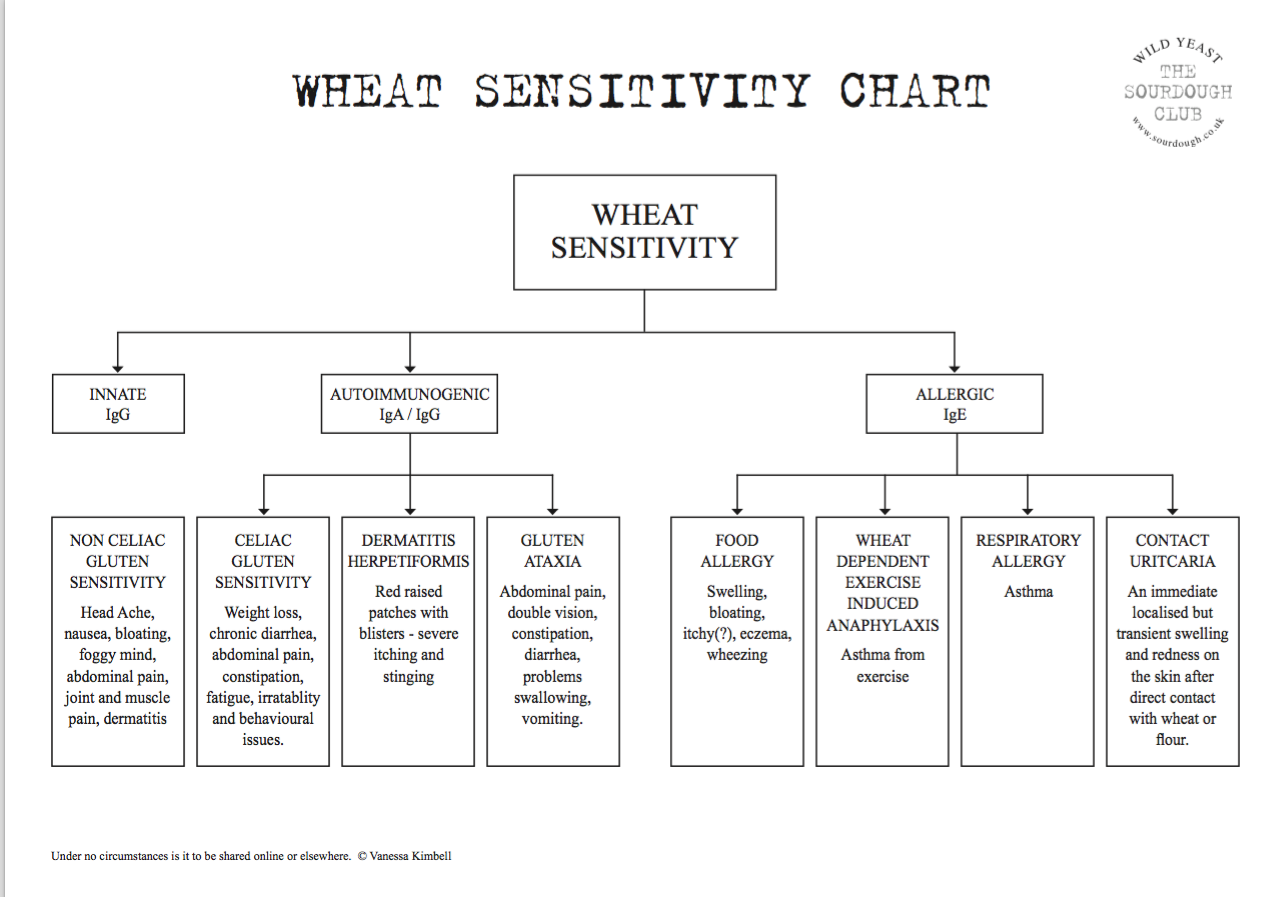
There are many kinds of wheat sensitivity - this chart  is a summary of the main ones
There are many kinds of wheat sensitivity – this is a summary of the main ones


Wheat Sensitivity: An Overview

Wheat sensitivity encompasses a spectrum of disorders that describe adverse reactions to wheat and related proteins, presenting a complex challenge in dietary management and health care. It can manifest through various immune-mediated pathways, including allergic, autoimmune, and possibly innate immune responses.

Innate IgG Wheat Sensitivity

Innate IgG wheat sensitivity involves the immune system’s IgG antibodies reacting to wheat proteins. Unlike immediate allergic reactions, IgG-mediated responses can be delayed, leading to a range of symptoms such as gastrointestinal discomfort, headaches, and fatigue. This type of sensitivity does not involve the same rapid immune response as IgE-mediated allergies but indicates a chronic, low-level immune activation against wheat components.

Autoimmunogenic Wheat Sensitivity: IgA and IgG Reactions

Autoimmunogenic wheat sensitivity with IgA and IgG immune reactions refers to conditions where the body’s immune system mistakenly targets its own tissues in response to wheat intake. These autoimmune responses can lead to conditions like coeliac disease, where IgA and IgG antibodies against specific wheat proteins cause damage to the intestinal lining, leading to nutrient malabsorption and a range of systemic symptoms.

Allergic Reaction: IgE Mediated

An allergic reaction to wheat involves IgE antibodies, which mediate immediate hypersensitivity reactions. This can lead to symptoms ranging from mild (hives, itching, swelling) to severe (anaphylaxis) shortly after wheat ingestion. IgE-mediated wheat allergy is distinct from other forms of wheat sensitivity due to its acute onset and potential severity.

Non-Coeliac Gluten Sensitivity

Non-coeliac gluten sensitivity (NCGS) is characterised by symptoms similar to coeliac disease, including headache, nausea, bloating, foggy mind, abdominal pain, joint and muscle pain, and sometimes dermatitis, but without the autoimmune intestinal damage seen in coeliac disease. NCGS is diagnosed after ruling out coeliac disease and wheat allergy, and symptoms improve on a gluten-free diet.

Coeliac Disease

Coeliac disease is an autoimmune disorder triggered by the ingestion of gluten, a protein found in wheat, barley, and rye. Individuals with coeliac disease experience immune-mediated damage to the small intestine, leading to symptoms like weight loss, chronic diarrhoea, abdominal pain, and fatigue, among others. Strict adherence to a gluten-free diet is essential for managing this condition.

Dermatitis Herpetiformis

Dermatitis herpetiformis is a skin manifestation of coeliac disease, characterised by raised, red patches and blisters that can be intensely itchy and sting. It results from the deposition of IgA antibodies in the skin. A strict gluten-free diet is the primary treatment to alleviate symptoms.

Gluten Ataxia

Gluten ataxia is an autoimmune condition where the ingestion of gluten leads to neurological symptoms, such as impaired coordination and balance (ataxia), double vision, and difficulties with swallowing. It can also present with gastrointestinal symptoms like abdominal pain, constipation, and diarrhoea. Elimination of gluten from the diet is crucial to manage and potentially improve neurological function.

Wheat-Dependent Exercise-Induced Anaphylaxis (WDEIA)

WDEIA is a rare, but serious, form of wheat allergy that occurs when physical activity follows the ingestion of wheat. Symptoms include asthma, urticaria, angioedema, and in severe cases, anaphylaxis. Avoidance of wheat prior to exercise and carrying emergency medication is advised for affected individuals.

Contact Urticaria

Contact urticaria from wheat involves immediate, localised, but transient swelling and redness of the skin upon direct contact with wheat or flour. It represents an IgE-mediated skin reaction, distinct from systemic wheat allergies, and requires avoidance of direct skin contact with wheat-containing products.

In managing wheat sensitivity, a nuanced approach is necessary. For autoimmunogenic and allergic conditions, strict avoidance of wheat and related proteins is often essential. However, for non-coeliac gluten sensitivity, personalisation and dietary adaptation, particularly towards long, slow fermented, whole grain bread, may allow for symptom management and maintenance of health. Always consult a healthcare provider for a tailored approach and diagnosis

All reasonable care is taken when writing about health aspects of bread, but the information it contains is not intended to take the place of treatment by a qualified medical practitioner. You must seek professional advice if you are in any doubt about any medical condition. Any application of the ideas and information contained on this website is at the reader's sole discretion and risk.

Learn more about…

The Sourdough
School
Attend a
Sourdough Retreat
Join Proven
Bread Classes
The Sourdough
School Diploma

Never miss a post

Enter your email address


About Dr Vanessa Kimbell

Dr Vanessa Kimbell is acknowledged as one of the world’s foremost authorities on bread and human health — the first person to hold a doctorate in Baking as Lifestyle Medicine and Preventative Healthcare, and the pioneer who, long before gut health became a mainstream concern, first identified the crucial role bread plays in the gut microbiome and mental wellbeing. A fourth-generation baker of Italian descent, she has been baking sourdough since the age of 11, served her traditional apprenticeship in the Dordogne, and is a time-served, French-trained qualified baker who has worked alongside some of the world’s greatest bakers including Richard Hart and Gabriele Bonci. She has spent four decades asking the questions the food industry preferred no one asked: why was industrial mono bread slowly harming us, and what would it take to make bread that genuinely nourishes?

The answer became her life’s work. As founder and Course Director of The Sourdough School in Northamptonshire — a world-renowned centre of research and education — she has taught bakers from over 84 countries, integrated the BALM (Baking as Lifestyle Medicine) Protocol into NHS clinical practice at Bethlem Royal Hospital, and developed Proven Bread: the first bread built on clinical evidence, personalised to the individual through nutrigenetics and gut microbiome assessment. She delivered the Royal College of General Practitioners‘ approved course in the Nutrition of Bread, has been a regular contributor to BBC Radio 4’s Food Programme for many years, and collaborates with leading scientists and clinicians including Professor Tim Spector — who credits her with teaching people to make the healthiest bread in the world — and Professor David Veale. Named the Sourdough Queen by The Telegraph in 2013, her influence reaches far beyond the classroom — from artisan bakers and healthcare professionals to the world’s leading food scientists and multinational food corporations.

A bestselling international author of five books, her sixth — Proven — publishes in November 2026.

More information about Vanessa can be found at
The Sourdough School,
The Sourdough Club,
on Instagram at @SourdoughClub,
@SourdoughSchool and
@vanessakimbell,
on Facebook and
LinkedIn.

Previous Post:The Sourdough Independent 2- 680The Sunday Independent on Sourdough
Next Post:We were included in The Telegraph top 10 baking courses in the UKsourdough and coffee on The Telegraph newspaper

Todays live for diploma students will be on 'How t Todays live for diploma students will be on 'How to engage your patient in the lifestyle changes of the BALM' with @vanessakimbell 

In their 6pm live session, we help keep our students on track with the syllabus and discuss the application of Baking As Lifestyle Medicine to the 6 pillars of Lifestyle medicine, applying the research papers, application of the Research, and how this ties into prescribing, along with guest lecturers, discussions and sharing knowledge.

#lifestylemedicine #health #functionalmedicine #nutrition #integrativemedicine #healthylifestyle #wellness #lifestyle #rcgp #dietitian #nutritionist #healthcareprofessional #holistichealth #healthyliving #plantbased #guthealth #naturopathicmedicine #selfcare #functionalnutrition  #naturopathicdoctor #foodasmedicine #foodismedicine #lifestylegoals #cpd #lifestylechange #mentalhealth #sourdough #sourdoughschool #bakeforhealth
BAKE, ANALYSE, EAT; RECALIBRATE & REPEAT. 📆 The S BAKE, ANALYSE, EAT; RECALIBRATE & REPEAT.

📆 The Sourdough School Clinic - Thursdays 8pm - for students of The Sourdough School 

✏️ In this weekly live session, we cover technical baking questions. Students can submit their Baking Record Sheets in advance of the session.

📋 We look at the details of our student's bakes - the specifics of the flour, timings and temperatures. Using our sourdough record sheets Vanessa will make suggestions on how they might modify, or recalibrate the next time they bake.

Follow the link in the bio to learn more about becoming a student at The Sourdough School 👆

#sourdough #sourdoughschool #bread #sourdoughlove #sourdoughlover #naturalleavened #leavening #levain #realbread #breadmaking #bakebread #makebread #makerealbread #learntobakebread #breadmakingclass #sourdoughstories #bakingforlove #bakingtherapy #sourdoughbaking
IBS AWARENESS MONTH Do you suffer from irritable IBS AWARENESS MONTH

Do you suffer from irritable bowel syndrome (IBS)? It can be tough to deal with the uncomfortable symptoms of stomach cramps, constipation, diarrhoea and bloating. But did you know that making dietary changes, such as incorporating sourdough bread into your diet, could help alleviate some of those symptoms?

Studies have shown that sourdough's long, slow fermentation process can reduce IBS symptoms. Plus, during #ibsawarenessmonth, we're exploring how adding different herbs and spices to your sourdough can further improve both the flavour and the digestion of your bread.

Let's talk about gut health, fermentation, and how sourdough can be a delicious and healthy addition to your diet. Join the conversation and share your experiences with IBS and sourdough.

#guthealth #healyourgut #healthygut #guthealing #guthealthmatters #letfoodbethymedicine #foodasmedicine #gutbrainconnection #nutrientdense #micronutrients #digestivehealth #nutritionfacts #microbiome #breadandguts #ibsawarenessmonth
THE SOURDOUGH SCHOOL – HAND CARVED WOODEN LAME On THE SOURDOUGH SCHOOL – HAND CARVED WOODEN LAME

One of the biggest issues around using a plastic lame to score sourdough, of course, is that eventually the blade will become blunt and the lame could end up in landfill.  So several years ago I talked to my dear friend EJ about developing a lame with a replaceable blade. And he came up with this very beautiful hand carved wooden lame.

Very sadly EJ is no longer with us. Recently a friend of EJ’s who is also a wood turner and carver offered to make these again for us in remembrance of our dear friend.

Follow the link in the bio to our shop where you can find our full selection of wooden sourdough tools 👆

#sourdough #sourdoughschool #bread #sourdoughlove #sourdoughlover #naturalleavened #leavening #levain #realbread #breadmaking #bakebread #makebread #makerealbread #learntobakebread #breadmakingclass #sourdoughstories #bakingforlove #bakingtherapy #sourdoughbaking
The Baking As Lifestyle Medicine (BALM) Protocol The Baking As Lifestyle Medicine (BALM) Protocol

The current food system is broken at multiple levels, from the pesticides used in our soils to the emulsifiers and additives adulterating industrially-processed foods. Nowhere is this more apparent than in the bread we eat.  The figures reported by the UK Flour Millers say that bread is bought by a staggering “99.8% of British households” and that “the equivalent of nearly 11 million loaves are sold each day. Approximately 60-70% of the bread we eat is white and sandwiches are thought to account for 50% of overall bread consumption. Average bread purchases are the equivalent of 60.3 loaves per person per year.” 

Most bread sold is made by modern processing methods that strip heart-healthy whole grains of their nutrient contents, resulting in low-fibre bread with a high glycemic index. Over time, white processed bread can increase a person’s risk of insulin resistance alongside other lifestyle diseases.

We’re on a mission to revolutionise the bread making process at every level – from soil to slice. The rules governing this are laid out in our Baking As Lifestyle Medicine protocol. 

#lifestylemedicine #health #functionalmedicine #nutrition #integrativemedicine #healthylifestyle #wellness #lifestyle #rcgp #dietitian #nutritionist #healthcareprofessional #holistichealth #healthyliving #plantbased #guthealth #naturopathicmedicine #selfcare #functionalnutrition  #naturopathicdoctor #foodasmedicine #foodismedicine #lifestylegoals #cpd #lifestylechange #mentalhealth #sourdough #sourdoughschool #bakeforhealth
Follow on Instagram

About

Email: [email protected]
Tel: +44 (0)7813308301

The Sourdough School Ltd
Registered in England & Wales: 08412236

Terms & Conditions

Privacy Policy

  • Facebook
  • Instagram
  • Pinterest
  • Twitter

Latest Posts

Glyphosate in Oats: Why Organic Matters more for some than others

What is the difference between Ambient and Retarded Sourdough?

Why You Feel Better Eating Bread on Holiday (And How to Fix It at Home)

What is Sourdough? The Complete Guide to Real Sourdough Bread

The Classic Diversity Sourdough Baguettes – Ambient

BANT Member
Lifecode GX

Subscribe

Enter your email address

Search


Terms & Conditions | Competition Terms & Conditions | Privacy Policy
Copyright © 2009–2026 Vanessa Kimbell | Login
Registered in England and Wales: 08412236
Website by Callia Web