• Skip to main content
  • Skip to after header navigation
  • Skip to site footer

The Sourdough School Magazine

How to fix your relationship with bread by Dr Vanessa Kimbell

For in person courses, consultations and training in BALM visit The Sourdough School, or book a 1:1 meeting to get your bread personalised.

WhatsApp / Email

  • Facebook
  • Instagram
  • Pinterest
  • Twitter
  • WhatsApp
Book Your Sourdough Course
Subscribe to our newsletter

.

  • About
    • Get in Touch
    • The School
    • Podcast on Apple
    • Podcast on Spotify
    • Dr Kimbell
    • What is Baking as Lifestyle Medicine?
    • Evidence Based
  • Courses
    • Online Diploma
    • Workshops
    • Baking Retreats
    • Personalised Bread Assessments
  • Baking
    • Recipes
    • Sourdough Ingredients
    • Books by Dr Kimbell
    • Sourdough Hydration Calculator
    • The Glossary
  • Bread & Health
    • Bread Health Calculator
    • Bread & Nutrition
    • Bread & Gut Health
    • Bread Matters
  • Flour
    • Flours from Farmers Directory
    • Add Farmer to the Directory
    • British Artisan Flour Mills by Region
  • Resources
    • Equipment advice pages
    • Sourdough Baking Equipment
    • Research papers

Hydration

Understanding Flour and Adjusting Hydration in Sourdough is key to success.

I’ve been baking for over 40 years so whenever I have students here they all tell me that they just want to follow the recipe right? So I am going to share here what I tell them. If you are working with artisan flour and wild yeast then you need to understand this – you have to feel the dough and connect to the amount of water it needs. Treat the suggested amount of water as a guide not as an absolute.

One of the beautiful yet challenging aspects of baking sourdough is the variability of flour protein, fibre and age of the flour will impact the final result. No two flours are the same, and understanding how to work with different types is key to successful baking. This is why adjusting hydration—the amount of water you add to your dough—is so important. The right hydration level can make the difference between a light, airy loaf and a dense, heavy one.

When I’m teaching or baking myself, I always start by considering the type of flour I’m using. Different flours absorb water differently, depending on their protein content, how finely they are milled, and even the climate where the grain was grown. These factors all affect how much water the flour can handle and, consequently, how much you should add during mixing. The level of hydration can be worked out here on my sourdough hydration calculator.

Getting to Know Your Flour

Start by getting to know your flour—each one has its own unique properties. Whole grain flours, for instance, absorb more water than white flours because they contain the bran and germ, which soak up more moisture. If you’re using whole wheat, rye, or spelt, you’ll likely need to increase the hydration level to get the right dough consistency. On the other hand, refined white flours, like all-purpose or bread flour, absorb less water and produce a softer, more elastic dough.

Another factor to consider is the age of your flour. Freshly milled flour behaves differently from flour that’s been sitting on the shelf for a while. Fresh flour might be more absorbent and require a bit more water, while older flour may not need as much.
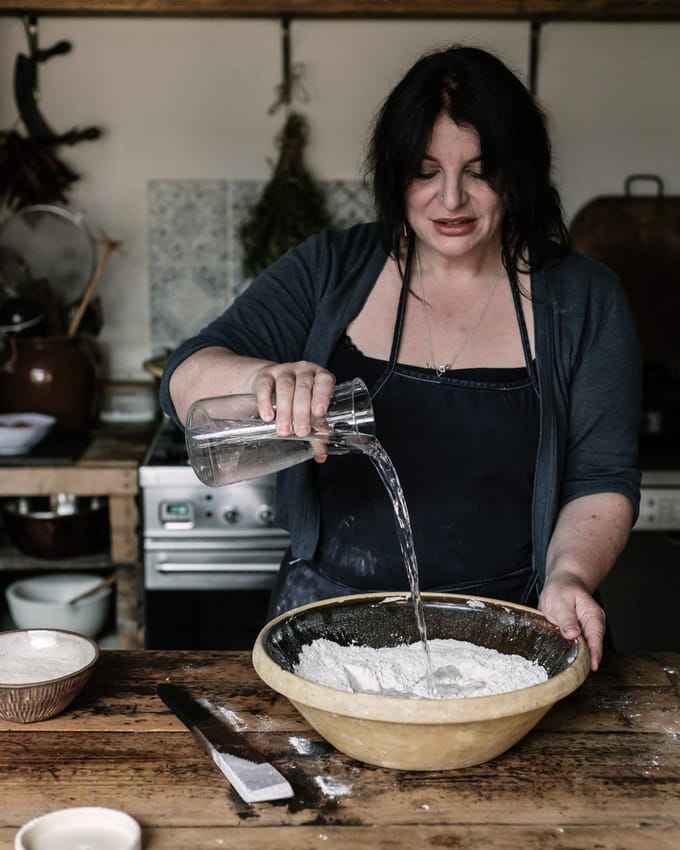
Dr Vanessa Kimbell adding water to sourdough

Adjusting Hydration: Start Slow and Observe

When adjusting hydration, I always recommend starting with less water than you think you need. It’s easier to add water than to take it away. Begin by adding about 70-75% of the water you would typically use. Mix your dough, then let it rest for a few minutes. This rest period, known as autolyse, allows the flour to fully hydrate and gives you a better sense of how much more water might be needed.

During this resting time, you can observe the dough’s texture and feel. Is it stiff and difficult to work with? It may need more water. Is it too sticky and hard to manage? You might have added too much. A well-hydrated dough should feel soft, slightly sticky to the touch, but still manageable. It should be able to stretch easily without tearing, indicating good gluten development.

Adjusting Hydration: Tips for Success

  1. Start with Less Water: Begin with 70-75% hydration and gradually add more as needed. This allows you to gauge the dough’s absorption capacity without overshooting.
  2. Consider Flour Type: Whole grain flours generally need more water than white flours. If you’re using a mix, adjust accordingly. You might need to experiment a little to find the right balance.
  3. Watch the Dough: During the autolyse phase, let the dough rest and absorb the water. Then, check its texture. If it feels too dry, slowly add more water. If it’s too wet, you can incorporate a bit more flour, but be cautious not to overdo it.
  4. Climate Matters: Flour behaves differently depending on the humidity and temperature. On a humid day, you might need less water, while in a dry environment, more water might be necessary. Be flexible and adjust based on the day’s conditions.
  5. Feel the Dough: Get your hands in there! Feeling the dough gives you valuable information about its hydration. A properly hydrated dough should feel smooth and supple, with a slight tackiness that indicates good moisture content.
  6. Take Notes: Every time you bake, take notes on the flour you used, the amount of water added, and how the dough felt. Over time, you’ll build a personal guide to how different flours and hydration levels work best for you.

Embrace the Variability

One of the joys of baking sourdough is embracing the variability of natural ingredients. Flour is a living product, full of nuances and surprises. By learning to adjust hydration and listening to what the dough needs, you develop a deeper understanding of the baking process and become a more intuitive baker.

Remember, there’s no one-size-fits-all when it comes to sourdough. Every flour is different, and every loaf is a new opportunity to learn and grow. Enjoy the journey, and happy baking!

THE CASCADE OF BIOLOGIICAL PROCESSES AS YOU ADD WATER 

I want to you understand water that as you add you water that a cascade of biological and chemical processes begins simultaneously:

  1. Hydration of Proteins: Gliadin and glutenin, the key proteins in wheat flour, absorb water and begin to interact, forming  gluten. This creates the elastic network that provides structure and strength to the dough. Which is why one of the key processes of a beautiful open crumb sourdough is developing gluten when mixing, but if you add in all the water at once you will get a soup-like consistency. You have
    to hold back some of the water.
  2. Enzyme Activation: Natural enzymes in the flour, such as amylase and protease, are activated. Amylase breaks down starches into simple sugars, providing food for yeast or bacteria, while protease starts breaking down proteins, affecting gluten development and dough extensibility. Which is why more water speeds up the rate of fermentation. 
  3. Starch Gelatinisation: Starch granules in the flour absorb water and swell, contributing to the dough’s viscosity and structure.
  4. Yeast Activation:  Water awakens yeast from dormancy. The yeast begins respiring and consuming simple sugars, producing carbon dioxide which raises to dough and ethanol as by-products.
  5. Microbial Activity: all the wild yeasts and lactic acid bacteria (LAB) on the flour and in the environment also become active. They start their jobs behaving like they are in the soil and breakdown sugars, producing acids that influence flavour and dough behaviour.
  6. Hydration of Cell Wall Polymers: Fibre components like arabinoxylans absorb water, creating a gel-like consistency that impacts the dough’s hydration and handling properties.

All these processes are interconnected, creating a dynamic system where water activates every component of the flour, setting the foundation for fermentation, flavour, and structure in bread.

Take a look at our courses at The Sourdough School

All reasonable care is taken when writing about health aspects of bread, but the information it contains is not intended to take the place of treatment by a qualified medical practitioner. You must seek professional advice if you are in any doubt about any medical condition. Any application of the ideas and information contained on this website is at the reader's sole discretion and risk.

Previous Post:Homofermentative lactobacilli
Next Post:Hygroscopic

Learn more about…

The Sourdough
School
Attend a
Sourdough Retreat
Join Proven
Bread Classes
The Sourdough
School Diploma

Never miss a post

Enter your email address


Todays live for diploma students will be on 'How t Todays live for diploma students will be on 'How to engage your patient in the lifestyle changes of the BALM' with @vanessakimbell 

In their 6pm live session, we help keep our students on track with the syllabus and discuss the application of Baking As Lifestyle Medicine to the 6 pillars of Lifestyle medicine, applying the research papers, application of the Research, and how this ties into prescribing, along with guest lecturers, discussions and sharing knowledge.

#lifestylemedicine #health #functionalmedicine #nutrition #integrativemedicine #healthylifestyle #wellness #lifestyle #rcgp #dietitian #nutritionist #healthcareprofessional #holistichealth #healthyliving #plantbased #guthealth #naturopathicmedicine #selfcare #functionalnutrition  #naturopathicdoctor #foodasmedicine #foodismedicine #lifestylegoals #cpd #lifestylechange #mentalhealth #sourdough #sourdoughschool #bakeforhealth
BAKE, ANALYSE, EAT; RECALIBRATE & REPEAT. 📆 The S BAKE, ANALYSE, EAT; RECALIBRATE & REPEAT.

📆 The Sourdough School Clinic - Thursdays 8pm - for students of The Sourdough School 

✏️ In this weekly live session, we cover technical baking questions. Students can submit their Baking Record Sheets in advance of the session.

📋 We look at the details of our student's bakes - the specifics of the flour, timings and temperatures. Using our sourdough record sheets Vanessa will make suggestions on how they might modify, or recalibrate the next time they bake.

Follow the link in the bio to learn more about becoming a student at The Sourdough School 👆

#sourdough #sourdoughschool #bread #sourdoughlove #sourdoughlover #naturalleavened #leavening #levain #realbread #breadmaking #bakebread #makebread #makerealbread #learntobakebread #breadmakingclass #sourdoughstories #bakingforlove #bakingtherapy #sourdoughbaking
IBS AWARENESS MONTH Do you suffer from irritable IBS AWARENESS MONTH

Do you suffer from irritable bowel syndrome (IBS)? It can be tough to deal with the uncomfortable symptoms of stomach cramps, constipation, diarrhoea and bloating. But did you know that making dietary changes, such as incorporating sourdough bread into your diet, could help alleviate some of those symptoms?

Studies have shown that sourdough's long, slow fermentation process can reduce IBS symptoms. Plus, during #ibsawarenessmonth, we're exploring how adding different herbs and spices to your sourdough can further improve both the flavour and the digestion of your bread.

Let's talk about gut health, fermentation, and how sourdough can be a delicious and healthy addition to your diet. Join the conversation and share your experiences with IBS and sourdough.

#guthealth #healyourgut #healthygut #guthealing #guthealthmatters #letfoodbethymedicine #foodasmedicine #gutbrainconnection #nutrientdense #micronutrients #digestivehealth #nutritionfacts #microbiome #breadandguts #ibsawarenessmonth
THE SOURDOUGH SCHOOL – HAND CARVED WOODEN LAME On THE SOURDOUGH SCHOOL – HAND CARVED WOODEN LAME

One of the biggest issues around using a plastic lame to score sourdough, of course, is that eventually the blade will become blunt and the lame could end up in landfill.  So several years ago I talked to my dear friend EJ about developing a lame with a replaceable blade. And he came up with this very beautiful hand carved wooden lame.

Very sadly EJ is no longer with us. Recently a friend of EJ’s who is also a wood turner and carver offered to make these again for us in remembrance of our dear friend.

Follow the link in the bio to our shop where you can find our full selection of wooden sourdough tools 👆

#sourdough #sourdoughschool #bread #sourdoughlove #sourdoughlover #naturalleavened #leavening #levain #realbread #breadmaking #bakebread #makebread #makerealbread #learntobakebread #breadmakingclass #sourdoughstories #bakingforlove #bakingtherapy #sourdoughbaking
The Baking As Lifestyle Medicine (BALM) Protocol The Baking As Lifestyle Medicine (BALM) Protocol

The current food system is broken at multiple levels, from the pesticides used in our soils to the emulsifiers and additives adulterating industrially-processed foods. Nowhere is this more apparent than in the bread we eat.  The figures reported by the UK Flour Millers say that bread is bought by a staggering “99.8% of British households” and that “the equivalent of nearly 11 million loaves are sold each day. Approximately 60-70% of the bread we eat is white and sandwiches are thought to account for 50% of overall bread consumption. Average bread purchases are the equivalent of 60.3 loaves per person per year.” 

Most bread sold is made by modern processing methods that strip heart-healthy whole grains of their nutrient contents, resulting in low-fibre bread with a high glycemic index. Over time, white processed bread can increase a person’s risk of insulin resistance alongside other lifestyle diseases.

We’re on a mission to revolutionise the bread making process at every level – from soil to slice. The rules governing this are laid out in our Baking As Lifestyle Medicine protocol. 

#lifestylemedicine #health #functionalmedicine #nutrition #integrativemedicine #healthylifestyle #wellness #lifestyle #rcgp #dietitian #nutritionist #healthcareprofessional #holistichealth #healthyliving #plantbased #guthealth #naturopathicmedicine #selfcare #functionalnutrition  #naturopathicdoctor #foodasmedicine #foodismedicine #lifestylegoals #cpd #lifestylechange #mentalhealth #sourdough #sourdoughschool #bakeforhealth
Follow on Instagram

About

Email: [email protected]
Tel: +44 (0)7813308301

The Sourdough School Ltd
Registered in England & Wales: 08412236

Terms & Conditions

Privacy Policy

  • Facebook
  • Instagram
  • Pinterest
  • Twitter

Latest Posts

Glyphosate in Oats: Why Organic Matters more for some than others

What is the difference between Ambient and Retarded Sourdough?

Why You Feel Better Eating Bread on Holiday (And How to Fix It at Home)

What is Sourdough? The Complete Guide to Real Sourdough Bread

The Classic Diversity Sourdough Baguettes – Ambient

BANT Member
Lifecode GX

Subscribe

Enter your email address

Search


Terms & Conditions | Competition Terms & Conditions | Privacy Policy
Copyright © 2009–2026 Vanessa Kimbell | Login
Registered in England and Wales: 08412236
Website by Callia Web